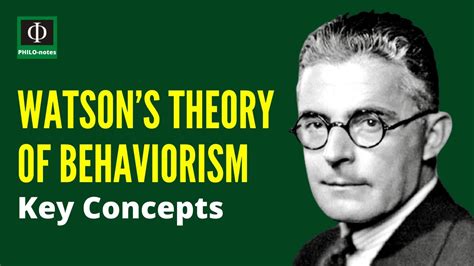
 John B. Watson was a pioneering psychologist who played an important role in developing behaviorism.
 A perhaps surprising influence on Watson’s early work was psychoanalysis, particularly the work of Sigmund Freud. Watson initially saw potential in psychoanalysis, appreciating its emphasis on early childhood experiences as shaping adult behavior, a concept he later integrated into his own theories.
John Watson was fascinated by the discoveries of psychoanalysis, but he rejected Freud's central concept of the unconscious as incompatible with behaviorism. Watson’s research directly contributed to behaviorism becoming the dominant psychological school of thought in the United States from the 1920s to the 1930s. John B. Watson's Early Life. John Broadus Watson was born on January 9, 1878 in Travelers Rest, South Carolina. His parents were Pickens Butler Watson and Emma Kesiah Watson.
John B. Watson, American psychologist who codified and publicized behaviorism, which, in his view, was restricted to the objective. Early Life of John B. Watson. John B. Watson was born on January 9, 1878, and grew up in South Carolina. He entered Furman University at the age of 16. After graduating five years later with a master's degree, he began studying psychology at the University of Chicago, earning his Ph.D. in psychology in 1903.
John b watson behaviorism theory summary
A perhaps surprising influence on Watson’s early work was psychoanalysis, particularly the work of Sigmund Freud. Watson initially saw potential in psychoanalysis, appreciating its emphasis on early childhood experiences as shaping adult behavior, a concept he later integrated into his own theories. How did john b watson die
John B. Watson, American psychologist who codified and publicized behaviorism, which, in his view, was restricted to the objective, experimental study of the relations between environmental events and human behavior.
John b watson contribution to psychology
Watson popularized Behaviorism. He was a radical behaviorist, an anti-mentalist, and, as such, criticized Sigmund Freud and psychoanalysis, as he claimed that the study of consciousness and introspection had no place in psychology as a science.
Where was john b watson born
Watson's often harsh criticism of Sigmund Freud has been given credit for helping to disseminate principles of Freudian psychoanalysis. Watson is widely known for the Little Albert study and his "dozen healthy infants" quote. John watson behaviorism theory
Watson used his behavioristic concept of conditioned emotional responses to compete with Freud's concepts of displacement and the unconscious transference of emotion. Behind a mask of anti-Freudian bias, Watson surprisingly emerges as a psychologist who popularized Freud and pioneered the scientific appraisal of his ideas in the laboratory. John b watson behaviorism theory pdf
John B. Watson was a pioneering psychologist who played an important role in developing behaviorism. He is remembered for his research on the conditioning process. Watson is also known for the Little Albert experiment, in which he demonstrated that a child could be conditioned to fear a previously neutral stimulus. John B. Watson: Contribution to Psychology John B. Watson (born January 9, 1878, Travelers Rest, near Greenville, South Carolina, U.S.—died September 25, 1958, New York, New York) was an American psychologist who codified and publicized behaviourism, an approach to psychology that, in his view, was restricted to the objective, experimental study of the relations between environmental events and human behaviour.John B. Watson | Contributions, Theory, & Biography - Britannica, carousel Enter John B. Watson, a name that would become synonymous with behaviorism and revolutionize the field of psychology. His story is one of innovation, controversy, and lasting impact. John B. Watson: The Father of Behaviorism. Born in 1878 in Travelers Rest, South Carolina, John Broadus Watson’s early life was marked by hardship and determination.John B. Watson: Founder of Behavioral Psychology Watson helped define the study of behavior, anticipated Skinner's emphasis on operant conditioning, and emphasized the importance of learning and environmental influences in human development. Watson's often harsh criticism of Sigmund Freud has been given credit for helping to disseminate principles of Freudian psychoanalysis. John watson experiment
Plato, Socrates, Aristotle, Descartes, Locke, Bacon Wilhelm Wundt, Edward Titchener, William James, Charles Darwin Sigmund Freud, John B. Watson, B.F. Skinner Empiricism Structuralism Introspection Functionalism Experimental psychology Behaviorism Humanistic psychology Cognitive neuroscience Nature-nurture issue Natural selection Levels of analysis Biopsychosocial approach Biological. John watson theory
Sigmund Freud - Key Takeaways. Sigmund Freud is known as the father of psychoanalysis. In his theory, Freud strongly believed that every personality is influenced by the unconscious mind. Freud’s theory of personality is also important because it is the foundation for his theory of ego defense mechanisms.